

Portable PID TVOC Detector for Lab R&D & Quality Testing
Release time:2026-07-04
Source:来源
Portable TVOC Detector Application: Laboratory R&D & Product Performance Validation
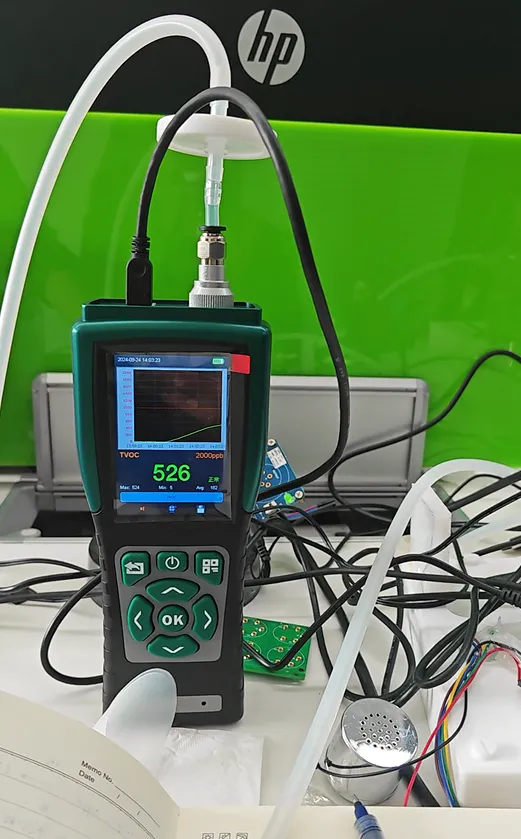
In indoor R&D and testing laboratories, engineers place this pump-suction TVOC detector on the workbench along with PCB circuit boards, electronic components, and connecting cables. With an external sampling gas path, the device supports both VOC emission testing of samples and self-calibration of the gas detector itself. This is a typical industrial R&D and quality inspection scenario, not ordinary household air testing.
Core Application Scenarios in Laboratory R&D
Electronic Component VOC Emission Testing
Electronic parts and materials will continuously release volatile organic compounds during production and use. In the R&D and quality inspection stage, this TVOC detector is used to test the VOC emission level of components, helping engineers verify whether the product meets environmental protection standards and optimize material formula and production process.
Gas Detector Calibration & Performance Verification
As a high-precision PID gas detector, the device needs regular calibration and performance verification in laboratory environments. Through standard gas sampling and comparison testing, laboratory personnel can confirm the detection accuracy, response speed, and stability of the instrument, ensuring reliable data output in subsequent on-site detection work.
Why TVOC Monitoring Matters? Key Values for Enterprises
Protect Personnel Health & Optimize Indoor Air Quality
TVOC is one of the core pollutants affecting indoor air quality (IAQ). At concentrations above 2000 ppb, TVOC will irritate the eyes, nose and throat, cause dizziness and nausea, and damage the respiratory and nervous systems. Long-term exposure also has carcinogenic risks. Real-time TVOC monitoring in laboratories and workplaces can effectively protect the health of R&D personnel and operators.
Meet Environmental Compliance & Emission Control Requirements
Industries such as chemical manufacturing, coating, electronics production and printing will discharge VOCs during production, which are important precursor pollutants of ozone and PM2.5. Most countries and regions in the world have issued VOC emission control standards. Enterprises need to use professional detectors to monitor emission concentration and ensure compliance with local environmental regulations.
Support Product R&D & Environmental Quality Verification
Products including electronic components, home building materials and automotive interiors will continuously release VOCs. By testing TVOC emission in R&D and quality inspection links, enterprises can verify whether products meet standards such as RoHS and CARB, and provide data support for product formula upgrading and process optimization.
Improve Occupational Health & Safety Management
The VOC concentration in industrial workplaces must meet the occupational exposure limit (OEL) standards. Regular or real-time TVOC detection can effectively prevent occupational poisoning incidents, help enterprises meet the requirements of occupational health and safety management systems such as ISO 45001, and reduce operational safety risks.
Highlights of This Pump Suction PID TVOC Detector
High-Precision PID Sensing Technology
Adopting photoionization detection (PID) principle, this volatile organic compound detector achieves high-precision TVOC concentration measurement with ppb-level resolution. It can sensitively capture trace VOC gas, fully meeting the precision requirements of laboratory testing and product verification.
Pump Suction Sampling for Efficient & Stable Testing
As a professional pump suction gas analyzer, the device has a built-in air pump and supports external gas path connection. It can quickly extract the gas to be tested for concentration analysis, with fast response speed and stable data, suitable for both fixed-point sampling and continuous monitoring in the laboratory.
Handheld Portable Design with Real-Time Data Display
This handheld VOC meter adopts an ergonomic portable design, equipped with a color display screen. It can show real-time TVOC concentration values (such as 526 ppb), concentration trend curves, and historical data statistics at a glance, making it convenient for engineers to operate and record during product debugging and testing.
Wide Applicability Across Industries
In addition to laboratory R&D and product quality verification scenarios, this industrial air quality TVOC monitor is also widely used in chemical plants, painting workshops, printing factories, electronic manufacturing workshops, indoor air quality testing, and workplace safety inspection. It provides reliable technical support for enterprises to carry out environmental management and occupational health protection.
Portable TVOC Detector Application: Laboratory R&D & Product Performance Validation
In indoor R&D and testing laboratories, engineers place this pump-suction TVOC detector on the workbench along with PCB circuit boards, electronic components, and connecting cables. With an external sampling gas path, the device supports both VOC emission testing of samples and self-calibration of the gas detector itself. This is a typical industrial R&D and quality inspection scenario, not ordinary household air testing.
Core Application Scenarios in Laboratory R&D
Electronic Component VOC Emission Testing
Electronic parts and materials will continuously release volatile organic compounds during production and use. In the R&D and quality inspection stage, this TVOC detector is used to test the VOC emission level of components, helping engineers verify whether the product meets environmental protection standards and optimize material formula and production process.
Gas Detector Calibration & Performance Verification
As a high-precision PID gas detector, the device needs regular calibration and performance verification in laboratory environments. Through standard gas sampling and comparison testing, laboratory personnel can confirm the detection accuracy, response speed, and stability of the instrument, ensuring reliable data output in subsequent on-site detection work.
Why TVOC Monitoring Matters? Key Values for Enterprises
Protect Personnel Health & Optimize Indoor Air Quality
TVOC is one of the core pollutants affecting indoor air quality (IAQ). At concentrations above 2000 ppb, TVOC will irritate the eyes, nose and throat, cause dizziness and nausea, and damage the respiratory and nervous systems. Long-term exposure also has carcinogenic risks. Real-time TVOC monitoring in laboratories and workplaces can effectively protect the health of R&D personnel and operators.
Meet Environmental Compliance & Emission Control Requirements
Industries such as chemical manufacturing, coating, electronics production and printing will discharge VOCs during production, which are important precursor pollutants of ozone and PM2.5. Most countries and regions in the world have issued VOC emission control standards. Enterprises need to use professional detectors to monitor emission concentration and ensure compliance with local environmental regulations.
Support Product R&D & Environmental Quality Verification
Products including electronic components, home building materials and automotive interiors will continuously release VOCs. By testing TVOC emission in R&D and quality inspection links, enterprises can verify whether products meet standards such as RoHS and CARB, and provide data support for product formula upgrading and process optimization.
Improve Occupational Health & Safety Management
The VOC concentration in industrial workplaces must meet the occupational exposure limit (OEL) standards. Regular or real-time TVOC detection can effectively prevent occupational poisoning incidents, help enterprises meet the requirements of occupational health and safety management systems such as ISO 45001, and reduce operational safety risks.
Highlights of This Pump Suction PID TVOC Detector
High-Precision PID Sensing Technology
Adopting photoionization detection (PID) principle, this volatile organic compound detector achieves high-precision TVOC concentration measurement with ppb-level resolution. It can sensitively capture trace VOC gas, fully meeting the precision requirements of laboratory testing and product verification.
Pump Suction Sampling for Efficient & Stable Testing
As a professional pump suction gas analyzer, the device has a built-in air pump and supports external gas path connection. It can quickly extract the gas to be tested for concentration analysis, with fast response speed and stable data, suitable for both fixed-point sampling and continuous monitoring in the laboratory.
Handheld Portable Design with Real-Time Data Display
This handheld VOC meter adopts an ergonomic portable design, equipped with a color display screen. It can show real-time TVOC concentration values (such as 526 ppb), concentration trend curves, and historical data statistics at a glance, making it convenient for engineers to operate and record during product debugging and testing.
Wide Applicability Across Industries
In addition to laboratory R&D and product quality verification scenarios, this industrial air quality TVOC monitor is also widely used in chemical plants, painting workshops, printing factories, electronic manufacturing workshops, indoor air quality testing, and workplace safety inspection. It provides reliable technical support for enterprises to carry out environmental management and occupational health protection.
no data
Contact Us





Fill out the form