

Flange-Mounted N2O Detector for Ducts
Release time:2026-09-20
Source:来源
Case Study: Real-Time Nitrous Oxide (N2O) Monitoring in Industrial Ducts
The Application Scenario: Direct Sampling in Exhaust Ducts
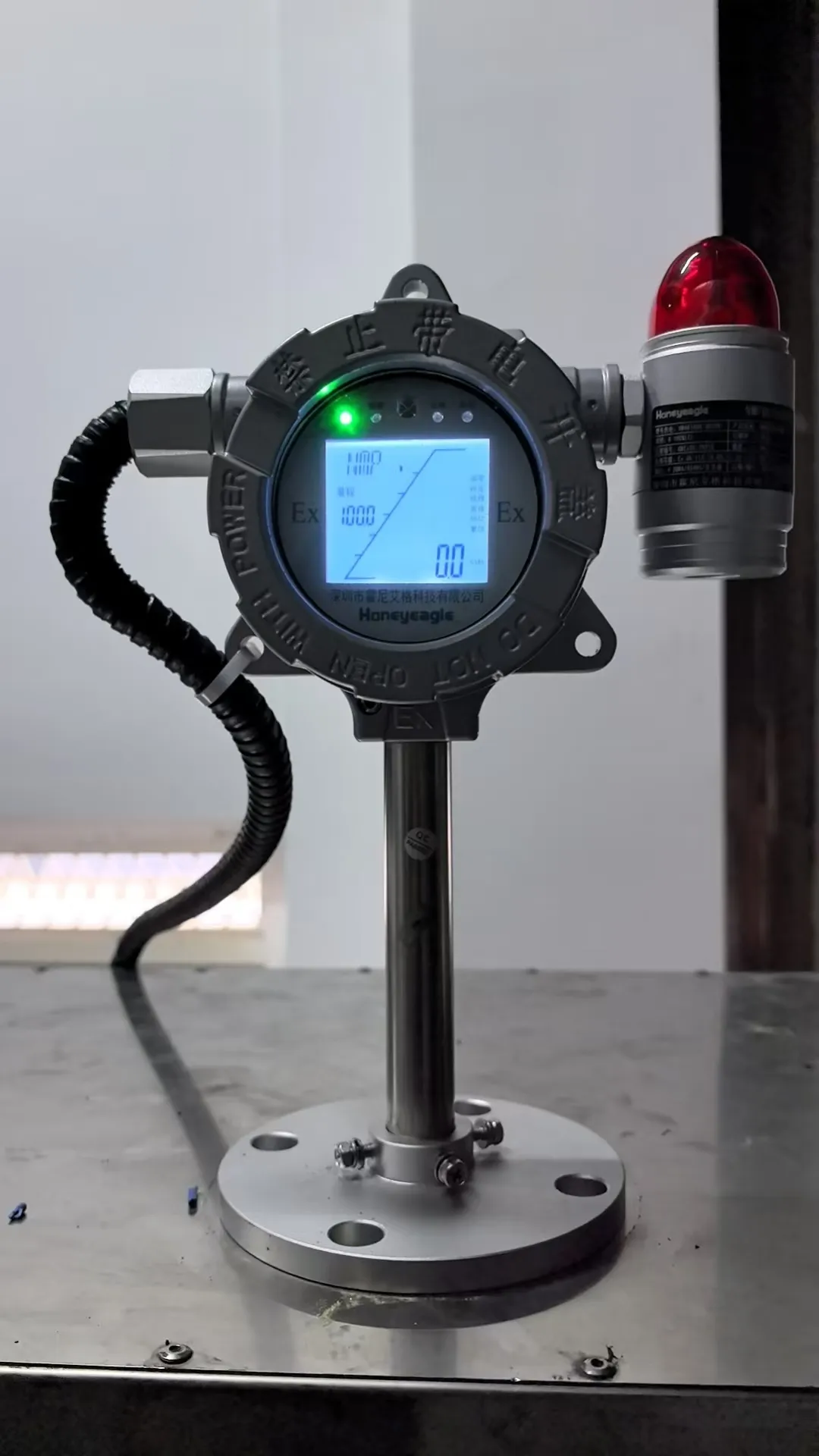
Installed vertically via a secure metal flange, this Insertion Type Gas Detector is designed for industrial ventilation ducts, exhaust pipelines, and enclosed reactor casings. The unique extended probe penetrates deep into the pipeline to directly contact and sample the internal airflow. Meanwhile, the explosion-proof main unit—equipped with a high-visibility digital display and a red strobe alarm—remains safely on the exterior. This structural design ensures that plant operators can easily read real-time data and perform routine maintenance without needing to open pipelines or shut down active process lines.
Why Monitor Nitrous Oxide (N2O)?
Nitrous Oxide (N2O) is a potent oxidizing agent and greenhouse gas commonly found in medical waste treatment, chemical synthesis, and combustion emissions. Utilizing a Flange-Mounted N2O Detector is critical for two primary reasons:
1. Preventing Combustion and Explosion Risks
In industrial exhaust systems, N2O acts as a strong oxidizer. If N2O accumulates inside a high-temperature duct alongside volatile fuels or organic compounds, it dramatically lowers the ignition threshold. A continuous Duct Gas Sensor ensures that N2O concentrations never reach dangerous levels, instantly triggering the exterior red alarm if risks escalate, thereby preventing secondary industrial explosions.
2. Ensuring Environmental and Health Compliance
Uncontrolled release of N2O poses severe health hazards (such as asphyxiation and central nervous system damage) to facility personnel and violates strict environmental emission protocols. By embedding a dedicated Nitrous Oxide Monitor directly into the exhaust flow, EHS directors obtain real-time, traceable data to guarantee that scrubbing systems are working effectively before the exhaust reaches the atmosphere.
Case Study: Real-Time Nitrous Oxide (N2O) Monitoring in Industrial Ducts
The Application Scenario: Direct Sampling in Exhaust Ducts
Installed vertically via a secure metal flange, this Insertion Type Gas Detector is designed for industrial ventilation ducts, exhaust pipelines, and enclosed reactor casings. The unique extended probe penetrates deep into the pipeline to directly contact and sample the internal airflow. Meanwhile, the explosion-proof main unit—equipped with a high-visibility digital display and a red strobe alarm—remains safely on the exterior. This structural design ensures that plant operators can easily read real-time data and perform routine maintenance without needing to open pipelines or shut down active process lines.
Why Monitor Nitrous Oxide (N2O)?
Nitrous Oxide (N2O) is a potent oxidizing agent and greenhouse gas commonly found in medical waste treatment, chemical synthesis, and combustion emissions. Utilizing a Flange-Mounted N2O Detector is critical for two primary reasons:
1. Preventing Combustion and Explosion Risks
In industrial exhaust systems, N2O acts as a strong oxidizer. If N2O accumulates inside a high-temperature duct alongside volatile fuels or organic compounds, it dramatically lowers the ignition threshold. A continuous Duct Gas Sensor ensures that N2O concentrations never reach dangerous levels, instantly triggering the exterior red alarm if risks escalate, thereby preventing secondary industrial explosions.
2. Ensuring Environmental and Health Compliance
Uncontrolled release of N2O poses severe health hazards (such as asphyxiation and central nervous system damage) to facility personnel and violates strict environmental emission protocols. By embedding a dedicated Nitrous Oxide Monitor directly into the exhaust flow, EHS directors obtain real-time, traceable data to guarantee that scrubbing systems are working effectively before the exhaust reaches the atmosphere.
no data
Contact Us





Fill out the form