

Coal Storage Shed Fixed Gas & Dust Monitoring System for Spontaneous Combustion Warning
Release time:2026-07-17
Source:来源
Working Condition Pain Points of Enclosed Coal Storage Shed
Poor Ventilation and Gas Accumulation Risk
Hidden Hazards From Stacked Raw Coal Piles
The site adopts corrugated color steel enclosure with weak air circulation. Massive raw coal lumps pile up and continuously release CH4, H2S, while internal heat buildup easily triggers coal spontaneous combustion and produces CO. Local gas concentration rises fast and causes explosion or poisoning risks.
Harsh Environment Damages Common Monitoring Devices
High Dust, Moisture and Corrosion Interference
Heavy coal dust, humid air and corrosive sulfur-containing gas will block ordinary sensors. Common household-grade detectors fail to meet explosion-proof standard and cannot work stably in this coal warehouse scenario.
Operation Obstacles of Ground Installation
Ground-laid monitors are easily hit by coal bulk materials, soaked by accumulated water and occupied by material stacking operation, bringing high maintenance cost and blind monitoring spots.
Integrated Dust & Multi-Gas Monitoring Layout Design
Sensor Division of the On-site Deployment
Function Match of Each Device
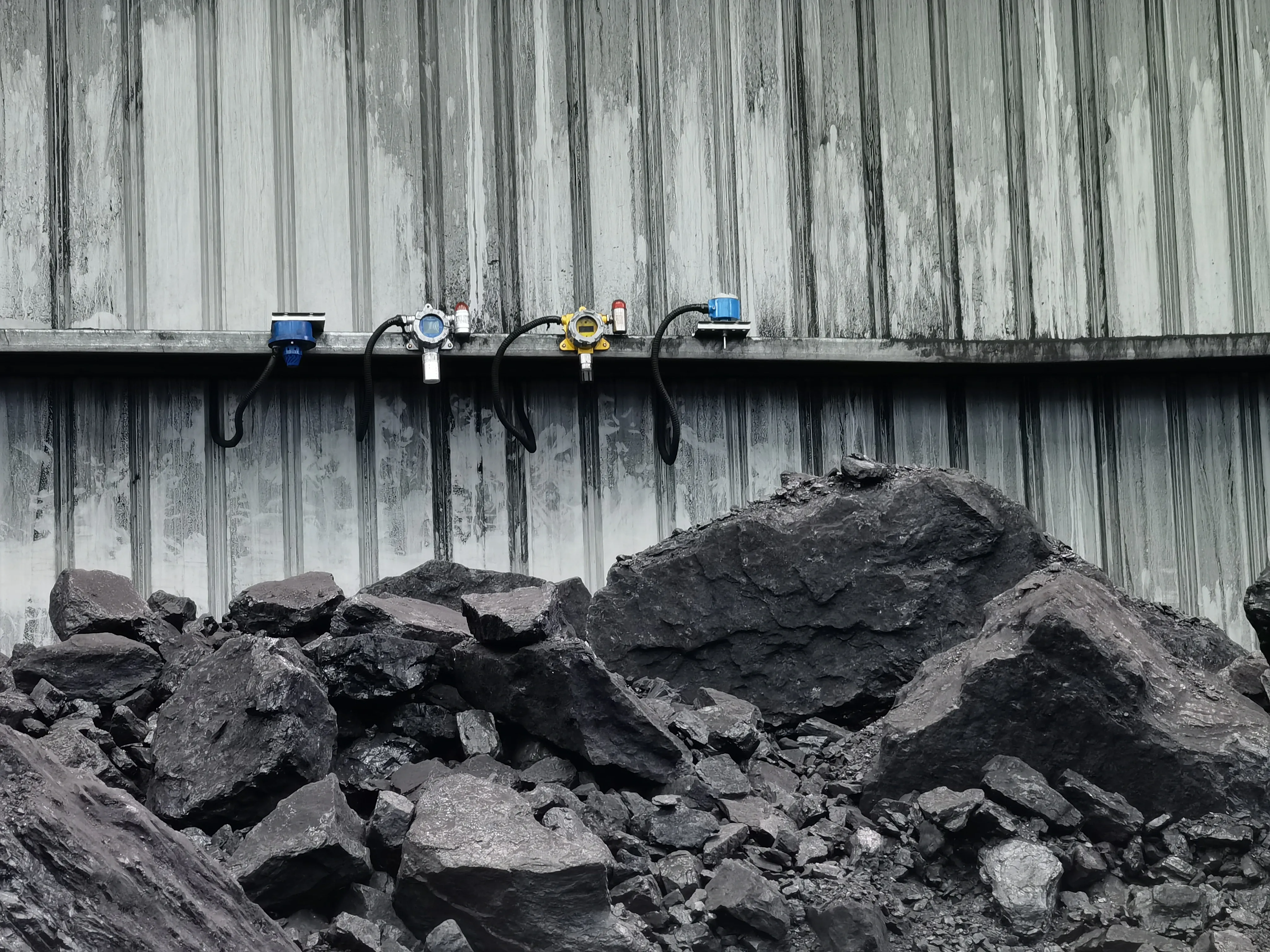
Two blue probes at both ends monitor total coal dust and inhalable PM concentration. Two middle explosion-proof gas detectors measure CH4, CO, H2S and O2 simultaneously, realizing four core goals: fire early warning, explosion prevention, toxic gas protection and dust emission control.
Upward Gas Capture Logic
Monitoring Point Height Advantage
All devices are installed above coal piles to catch upward diffused gas and dust released from coal mass, avoiding monitoring dead zone caused by uneven coal stacking.
Overhead Beam Wall-mounted Installation Advantages
Protection for Monitoring Hardware
Mounting on upper steel beam keeps sensors away from ground water, material collision and daily loading & unloading abrasion, lowering device failure rate.
Site Space Optimization
This installation mode does not occupy coal yard stacking and operation space, wiring is neat and will not interfere with normal raw coal handling workflow.
Compliance Value for Coal Industry Clients
Three Major Regulation Demands Covered
This solution satisfies safety explosion-proof specifications for coal storage, environmental dust discharge limits and coal spontaneous combustion prevention management requirements for thermal power plants, coking plants and bulk coal storage enterprises.
Expandable Monitoring Options
Extra sensors for SO2 and VOC can be added to detect more flue gas and volatile pollutants generated during coal long-term storage.
Working Condition Pain Points of Enclosed Coal Storage Shed
Poor Ventilation and Gas Accumulation Risk
Hidden Hazards From Stacked Raw Coal Piles
The site adopts corrugated color steel enclosure with weak air circulation. Massive raw coal lumps pile up and continuously release CH4, H2S, while internal heat buildup easily triggers coal spontaneous combustion and produces CO. Local gas concentration rises fast and causes explosion or poisoning risks.
Harsh Environment Damages Common Monitoring Devices
High Dust, Moisture and Corrosion Interference
Heavy coal dust, humid air and corrosive sulfur-containing gas will block ordinary sensors. Common household-grade detectors fail to meet explosion-proof standard and cannot work stably in this coal warehouse scenario.
Operation Obstacles of Ground Installation
Ground-laid monitors are easily hit by coal bulk materials, soaked by accumulated water and occupied by material stacking operation, bringing high maintenance cost and blind monitoring spots.
Integrated Dust & Multi-Gas Monitoring Layout Design
Sensor Division of the On-site Deployment
Function Match of Each Device
Two blue probes at both ends monitor total coal dust and inhalable PM concentration. Two middle explosion-proof gas detectors measure CH4, CO, H2S and O2 simultaneously, realizing four core goals: fire early warning, explosion prevention, toxic gas protection and dust emission control.
Upward Gas Capture Logic
Monitoring Point Height Advantage
All devices are installed above coal piles to catch upward diffused gas and dust released from coal mass, avoiding monitoring dead zone caused by uneven coal stacking.
Overhead Beam Wall-mounted Installation Advantages
Protection for Monitoring Hardware
Mounting on upper steel beam keeps sensors away from ground water, material collision and daily loading & unloading abrasion, lowering device failure rate.
Site Space Optimization
This installation mode does not occupy coal yard stacking and operation space, wiring is neat and will not interfere with normal raw coal handling workflow.
Compliance Value for Coal Industry Clients
Three Major Regulation Demands Covered
This solution satisfies safety explosion-proof specifications for coal storage, environmental dust discharge limits and coal spontaneous combustion prevention management requirements for thermal power plants, coking plants and bulk coal storage enterprises.
Expandable Monitoring Options
Extra sensors for SO2 and VOC can be added to detect more flue gas and volatile pollutants generated during coal long-term storage.
no data
Contact Us





Fill out the form